How to Draw a Ridge in a Site Plan
nine. TOPOGRAPHICAL PLANS AND MAPS
9.0 Introduction | ||
What are topographical plans and maps? | ||
| 1. Topographical plans and maps are drawings which evidence the main physical features on the ground, such as buildings, fences, roads, rivers, lakes and forests, too as the changes in peak betwixt land forms such as valleys and hills (called vertical relief). You base these plans and maps on the information you collect from topographical surveys. 2. Plans are usually large-scale drawings; maps are commonly minor-scale drawings. Depending on the scale you use to brand the drawing (see Section 9.i):
| Plan | |
| Case
3. Plans and maps have two main purposes in fish-farm structure. They assistance guide you in choosing a site, planning the fish-farm, and designing the structures that are needed for the farm. Plans and maps too guide you as y'all lay out marks on the ground, so that you tin follow the plan y'all take made of the fish-subcontract, and build the structures on it correctly. | Map | |
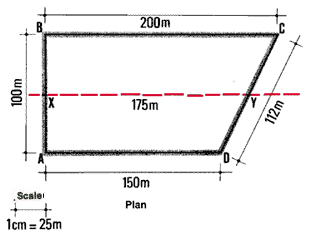
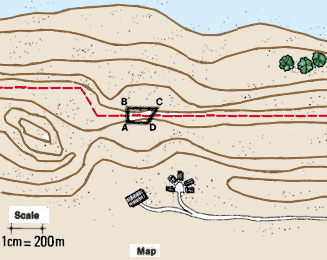
Starting topographical plans and maps
4. Before you brainstorm a topographical survey, you should effort to get any available topographical plans and maps of the area, fifty-fifty though they may not be exactly the kind of plan or map that you need. General topographical maps are bachelor from governmental organizations which are responsible for geological surveys or land surveys, for example. National geographical institutes, soil survey departments and agricultural development agencies tin also usually provide existing topographical maps. The cadastral department (that calculates state taxes) of your local government may provide local topographical plans.
5. You lot will often accept to make the topographical plans and maps yourself, however. You lot volition base them on a programme survey (see Chapter vii) and straight levelling (meet Chapter viii). In the following sections, you will larn how to:
- make the plan or map direct in the field by plane-tabling (run into Section 9.ii); or
- make the plan or map from the field measurements recorded in your notebook (see Sections 9.3-9.six).
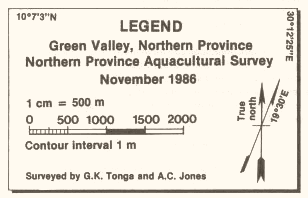
6. On topographical plans or maps, you should always look for:
- the proper name of the area or piece of land mapped, and/or the name of the type of projection for which information technology is used;
- the exact location of the slice of land;
- the proper noun of the person or people who fabricated surveys on which the plan or map is based;
- the date(s) on which the surveys were made;
- the management of magnetic north ;
- the scale at which the programme or map was drawn (see Section nine.1);
- the contour interval, if the vertical relief is shown (see Section 9.three);
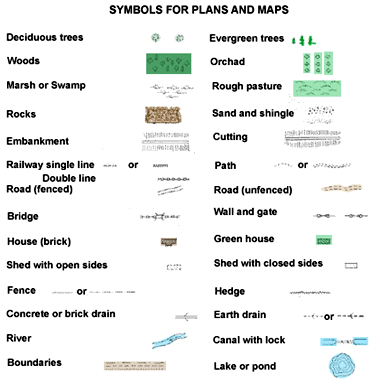
- a central, or guide, to the symbols used in the drawing.
This data is ofttimes located in one corner of the map. It is called the legend .
| | |
9.ane How to brand scales for plans and maps | ||
What is the scale of a plan or map? | ||
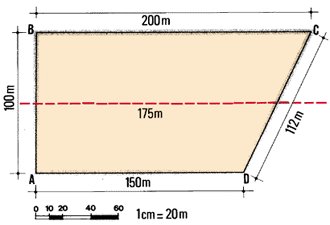
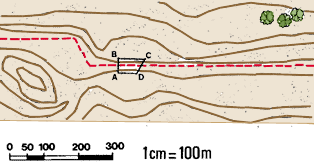
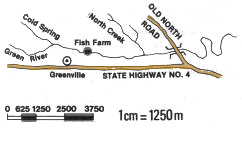
| 1. To represent distances y'all accept measured in the field on a slice of paper, you demand to scale them down. This ways that yous must reduce the size of the distances proportionally according to a calibration. The scale expresses the relationship which exists between the altitude shown on a drawing or map and the bodily distance beyond the ground. | | |
| Example
| | |
| Note: a ratio with a smaller number is a larger scale, that is, ane: 500 is a larger scale than 1 : 1000. | | |
Expressing a calibration
two. There are iii ways of expressing the scale of a cartoon:
- as a numerical equivalent such every bit " ane cm = 20 m", which you should read as "i cm on the programme represents 20 k on the ground";
- as a ratio such as " i: 2 000" which you should read as " ane cm on the plan represents 2 000 cm = 20 chiliad on the ground";
- graphically, with a line that is marked off into drawing distances that correspond to convenient units of altitude on the footing.
3. Table 11 gives the numerical equivalents of the most mutual scales, expressed every bit fractions. Scales for both distances (in metres) and surface areas (in square metres) are shown also.
Choosing a scale
4. General topographical maps usually have scales ranging from one:50000 to 1:250000. These are small-scale maps. In nigh countries, i :50000 maps are now available. You can use these for general planning of aquaculture development, including the planning of your fish-subcontract.
5. To show greater detail, plans are drawn to a larger calibration, showing individual structures or land areas. The scales most often used in plans are 1 :500, i :grand, 1 :2000, 1:2500 and i:5000. Detailed technology drawings use scales much larger than i:500, for example
1 : 100 or 1: ten.
Notation : special rulers, called "Kutsch" scales or reduction scales, make it easy to transfer ground distances onto drawings.

TABLE 11
Distances and surface areas expressed by scales
| Scale | Distance: 1 cm equals (m) | Surface area: 1 cm2 equals (m2) | |
| one: | 300 | 3 | 9 |
| 500 | five | 25 | |
| 600 | half dozen | 36 | |
| 1000 | 10 | 100 | |
| 1200 | 12 | 144 | |
| 1500 | 15 | 225 | |
| 2000 | twenty | 400 | |
| 2500 | 25 | 750 | |
| 5000 | 50 | 2500 (0.25 ha) | |
| one: | 10000 | 100 | 10000 (i ha) |
| 25000 | 250 | 62500 (6.25 ha) | |
| 50000 | 500 | 250000 (25 ha) | |
| 100000 | 1000 (i km) | 1000000 (100 ha) (1 km2) | |
| 125000 | 1250 | 1562500 (156.25 ha) | |
| 200000 | 2000 | 4000000 (400 ha) | |
| 250000 | 2500 | 6250000 (625 ha) | |
ix.2 How to make a map by aeroplane-tabling | ||
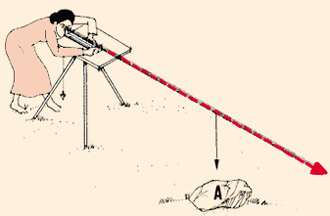
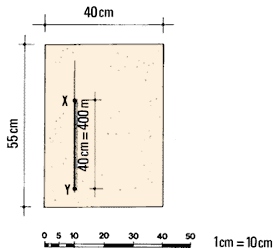
| ane. In Section 7.5, you read that yous tin apply a plane-table to brand a reconnaissance survey and to plot details. In this section, yous will acquire how to do this. It is best to use an alidade for this method (see Section vii.5, steps 21-28), but you lot can use a simple ruler, and a series of tailor's pins to show the observed directions, instead. 2. First, choose an appropriate scale for the map you will draw (meet Department nine.i, steps 4 and 5). Get an estimate of the longest distance you need to map, and determine upon the size of the map you require. If the map is to be adequately large, you can describe information technology on several sheets of paper, and glue them together. | | |
| Example
| | |
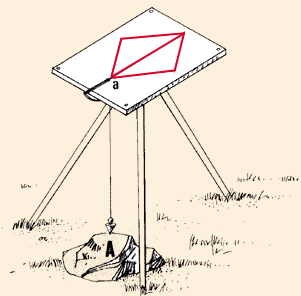
| iii. Encompass the board of your plane-tabular array with paper (see Department 7.five, steps 34-39). Fix up the plane-tabular array (come across Section 7.5, steps 40-44) on or near some major feature A of the area you demand to map, such as a large rock, a path, a river or a tall tree. four. Using a well-sharpened pencil with a hard pb, marking a small point and circle on your paper. This is point a, the location of the major characteristic, where you have prepare upwardly your aeroplane-table. Be certain to choose a department of the newspaper from which you can later map the unabridged area. For example, if you volition be mapping only ahead of betoken A, begin nigh the centre of the bottom margin of the plane-tabular array. Note : you will identify concrete features in the field that you lot need to map with capital letters. You volition identity the corresponding points that you lot draw on the plane-table sheet with lower-case letters . | Set the plane-table at point A | |
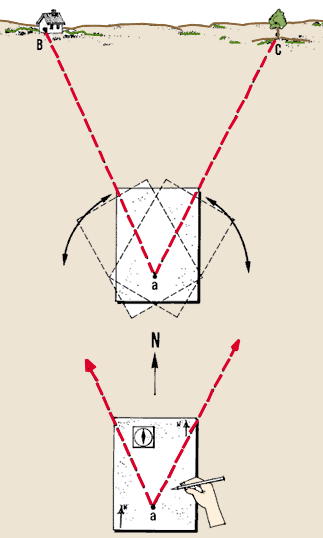
| 5. Rotate the table so that you will be drawing the map in the orientation you lot need. Using your magnetic compass equally a guide, draw arrows showing the magnetic north (see Section 7.5, steps 45-46). Annotation : you should always try to locate the due north facing the top of your map. This is a rule which is always practical in professional person topographical maps. You may not be able to follow the dominion, nevertheless, depending on the direction of the longest altitude and on the scale you select. | | |
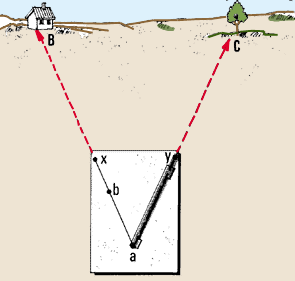
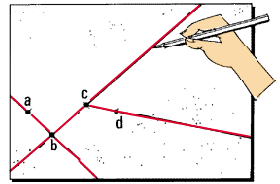
| six. Using your alidade , sight from the first marked point a to another major characteristic B which you can run into from the aeroplane-table location. This could be a small hill, a bend in a path or a ranging pole. Depict a sparse line ax in this direction. Note : yous can utilize the alidade much more hands if you place a pin at point a on the board, and so swivel the alidade around the pin until you can sight the second point. | Describe ax | |
| seven. Measure the horizontal footing altitude from the plane-table station A to the major feature B. So mark this distance along line ax , starting at point a and scaling it downward every bit line ab . eight. Without moving the plane-table from point A , echo this process for all other major features C, D, etc. which you tin can meet, and describe lines ac, advertizement, etc. | Describe ay | |
| nine. Move the airplane-tabular array to one of the major features y'all have just mapped, such as C. Cull a characteristic from which you tin can easily map some other part of the area, such as the route of a path or the course of a river. 10. Set up the airplane-table over this point C. Reorient the tabular array. Use the compass and the magnetic due north arrows y'all have already drawn (see step 5 above), or, instead, utilise the alidade, backsighting forth a drawn line which passes through the new station C and a known major characteristic such as A (meet Section seven.v, step 47). | | |
| 11. From this new station C , map in the new major features which you can run into, as explained above. 12. If necessary, motility to other stations to complete the mapping of the entire expanse. If you lot need more details in the map, go dorsum to ane of the mapped features, reorient the table by backsighting on some other mapped feature, and map the details as required. | | |

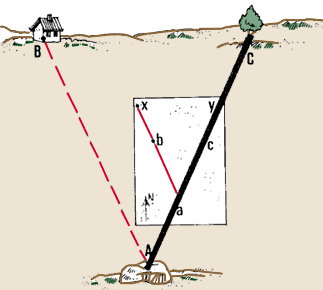
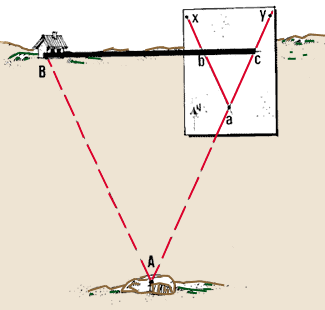
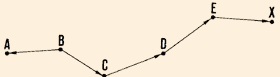
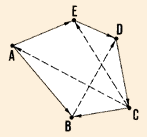
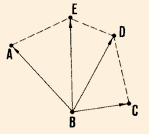
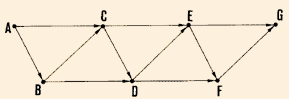
13. You can use the above procedure for plane-tabling in several different situations in the field, such as:
- mapping an open up traverse ;
- mapping a closed traverse;
- mapping by the radiating method;
- mapping by the triangulation method.
Normally, you lot will use a combination of some of these surveying methods to map an unabridged expanse.
| Open traverse | Airtight traverse | |
| Radiations | Triangulation |
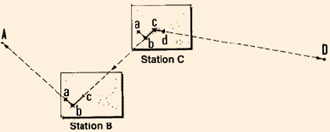
Mapping an open traverse with a plane-tabular array | ||
| 14. You may demand to map an open traverse ABCD. To do this, yous can, for example, first prepare the plane- table at point B, which has a stock-still position and from which a line BA of known direction already exists on the ground. Map the location of station B, the management of BA and the distance BA in turn. xv. Draw the direction of the side by side station C, measure distance BC, and map indicate c . | | |
| sixteen. Move the aeroplane-table to station C, orient it along CB, and, using the same procedure as in a higher place, map point d . Note : if the traverse sections ba, cb, etc. on the map are very short, you lot should marker their directions on the edge of the paper. This volition provide longer lines, then that you lot can line upward the alidade forth them when you must reorient the aeroplane-table at a new station by backsighting. | At C, accept a backsighting to B, and map D | |
| Prolong lines for easier orientation | ||
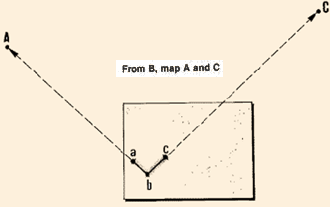
Mapping a closed traverse with a plane-table | ||
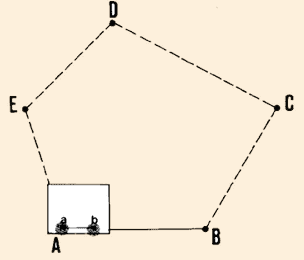
| 17. You need to map a closed traverse ABCDEA. Kickoff, set up the plane-tabular array at station A and plot this on paper as point a; choose a scale and a location on the paper which will allow you to plot the other stations within the limits of the sheet of paper. eighteen. Using the alidade, take a foresight through bespeak a to station B and draw line ax . Measure distances AB and map bespeak b on line ax . | | |
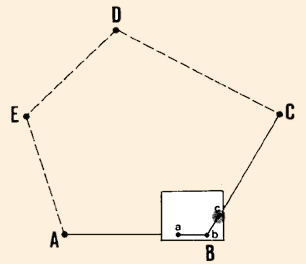
| nineteen. Motion the plane-table to station B, set information technology up over the point, and orient information technology past backsighting along line ba on station A. Take a foresight to station C, measure distance BC, and map point c . | | |
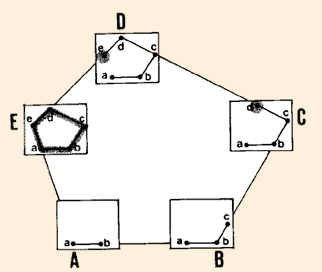
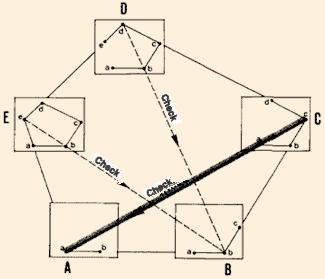
| xx. Using this procedure, map the locations of the remaining points on the closed traverse. At the end of the traverse, when yous plot the initial station A once more, you can see any error of closure. If this error is inside reasonable limits, correct it, using the graphic method explained in Section seven.1, step xix. | | |
| 21. From one station on the traverse, you may be able to see two or more of the preceding stations which are not on the same straight line equally the station where yous are continuing (for instance, from C to A, from D to B, or from East to B). In this case, check the other parts of the traverse. Case From station C, station A is visible. You should cheque from C the position of point a by backsighting on Station A. | Take additional backsights to check your work | |
Mapping with a aeroplane-table past radiating | ||
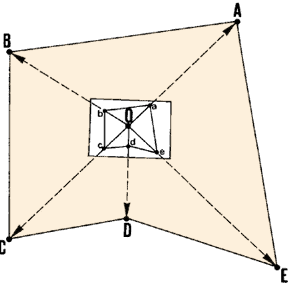
| 22. To use this method, prepare upwards the airplane-tabular array at a central station 0, from which yous can see all the points you need to map. Orient the tabular array. On the map, draw lines representing the directions to these ground points; to exercise this, pivot the alidade around the mapped location of station 0. Measure out horizontal distances OA, OB, OC, OD and OE, and scale them along each of the fatigued lines to map points a, b, c, d and e . | Move the alidade, but non the airplane-table | |
Mapping with a plane-table by triangulation | ||
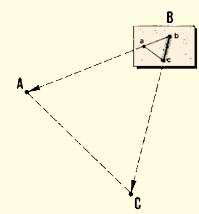
| 23. Before you kickoff aeroplane-tabling, you lot need to discover a base line determined past 2 known points visible from each other . This base line can exist a known section of an existing traverse, or a line between two points stock-still by a previous triangulation. If such a base line is not available, you must accurately determine and measure 1. 24. Draw the base line AB on the plane-table canvas. Choose a location which will let you to plot the other features of the map inside the limits of the sheet of paper. 25. Fix the plane-tabular array over one of the ii end-points of this base line, at point A, for example. So, with ranging poles, conspicuously mark the 2nd stop-point B, and the third bespeak C that you need to map. You should be able to see point C from both point A and point B . 26. Marshal the alidade along line ab, which represents the base of operations line; orient the airplane-table by sighting at the other end-point B of the base along AB. | Start from the known base-line | |
| 27. Identify a pin at indicate a and rotate the alidade around it until you sight point C . Describe a sparse line from point a forth the edge of the alidade in the direction of indicate C. | Map C from A... | |
| 28. Move the plane-table to B. Orient the table with line ba on the map pointing in the direction of ground signal A. Place a pin at b and rotate the alidade effectually information technology until you sight indicate C. Depict a thin line from point a in the direction of C. Point c is located on the map at the intersection of line air conditioning (step 27) and line bc. | ... and from B | |
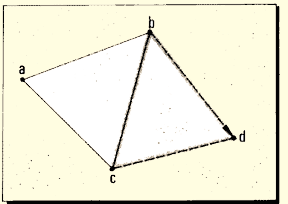
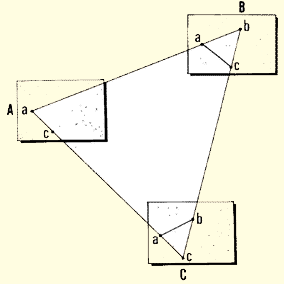
| 29. Point C is now known, and yous can use information technology in a similar style to determine other points, taking, for example, BC as a base of operations line to determine D. You can and so echo this mapping process, using each signal as information technology becomes known, equally long as each point you need to map is visible from ii other known points. | Motility to the next triangle | |
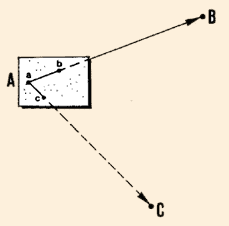
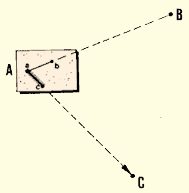
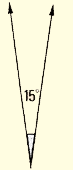
| 30. To check how accurately you accept mapped a new signal, set the plane-tabular array over the respective bespeak in the field. So orient the table along 1 line in the field and take a backsight to cheque that the second line on the map corresponds with the right line in the field. Annotation : you lot can obtain the best results if y'all use triangles with equal sides . The summit angles in these triangles are all equal to 60�. In all cases, you should avoid angles smaller than 15� or larger than 165�. | Check your piece of work by backsighting | |
| Cull the proper angle | ||||
| Too pocket-size | Likewise large | Best angle |
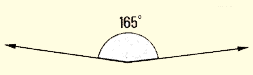
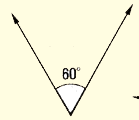
Mapping with a plane-tabular array by combined methods | ||
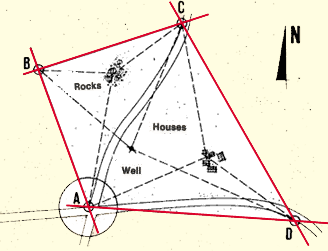
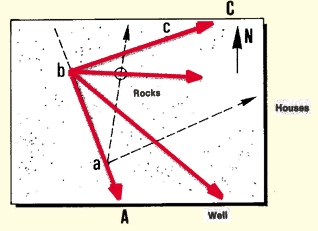
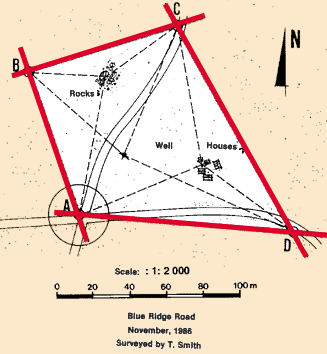
| 31. In most cases, yous will map an area with a airplane-table past using a combination of the methods of traversing, radiating and triangulation. 32. You need to map site ABCDA, which includes such features as a rocky area, a grouping of houses and a well. Clearly mark points A, B, C and D with ranging poles. | Site ABCDA | |
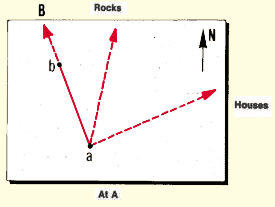
| 33. Set upwards the plane-table at corner A of the area. Locate the mapped position of A on the sheet of newspaper. Be sure to choose a point which will allow you to plot the other features of the map within the limits of the sheet of newspaper at the drawing scale you have chosen. Orient the sheet past drawing the direction of magnetic due north. 34. From station A, you can see the rocks and the houses. Past radiating, determine the directions of the rocks and the houses from this station. Then measure and map AB. | | |
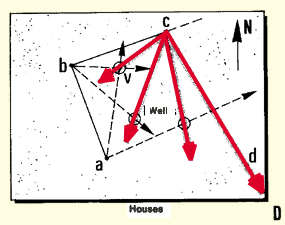
| 35. Motion the plane-tabular array and set it upward over corner B. Roughly orient the board past backsighting to A, and check this orientation with the magnetic compass. 36. From station B, you can see the rocks and the well. By radiating and triangulation, locate and map the rocks, and determine the direction of the well. Mensurate and map BC. | At B | |
| 37. Echo this procedure at indicate C, from which you lot can check on the position of the rocks and locate the well and the houses. Measure out and map CD. | At C | |
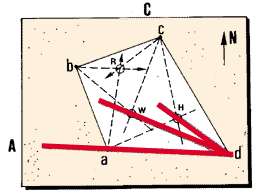
| 38. Repeat this process at signal D, from which you tin can check on the positions of the houses and the well. Measure and map DA. | At D | |
| 39. Check the error of closure of traverse ABCDA and correct it, if possible. If the error is too great, echo the survey. xl. Cease the map, checking that yous have included all the information you need (see Section ix.0, step 6). | Finished map | |
9.3 How to map by protractor and calibration | ||
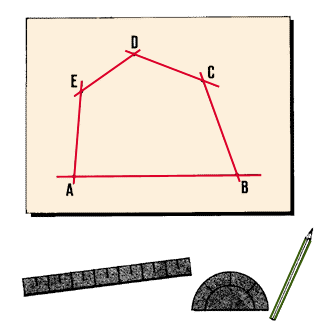
| 1. When yous map in the office, using field records, y'all will unremarkably plot horizontal distances with a ruler/calibration, and the horizontal angles with a protractor (encounter Section iii.3). 2. Kickoff, using the scale you lot have chosen, make a crude sketch of the area to determine its size and shape. From this sketch, decide how large a piece of newspaper yous will need to brand everything fit and determine the position of your map on the sheet of paper. | | |
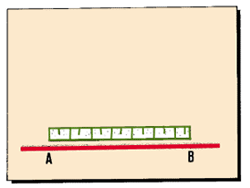
| 3. Draw the kickoff line in the right place on the newspaper and determine its length AB, using the selected scale. Using a pencil with a hard lead, accurately mark points A and B on the paper as two dots with a small circle around each. Note : draw the line so that it will extend beyond the next angle-point B , a distance greater than the radius R of the protractor. | | |
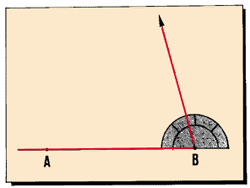
| 4. Place the protractor along line AB so that:
| | |
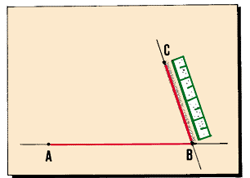
| 5. Plot the angle, which yous take obtained from your field notes, remove the protractor, and draw the second line. Locate and map point C according to the measured altitude and scale. | | |
| half-dozen. Place the protractor forth this concluding line with its centre opposite point C. Lay out the measured bending, and draw the 3rd line. Locate and map indicate D co-ordinate to the measured distance and scale. seven. Echo this process until you lot accept mapped the entire traverse. | | |
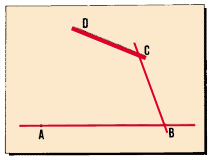
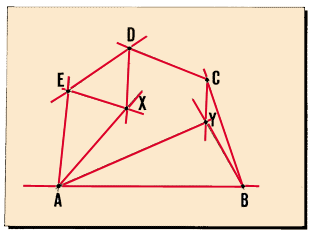
| 8. Locate the details on the plan from this traverse line. Plot the positions of buildings, fences, rocky areas, streams, paths, etc., using the scale for distances and the protractor for angles. 9. Y'all can use a method similar to this ane to map survey information which yous have obtained past radiating, past triangulation, and by offsets. | |
9.4 How to map contours
What is a profile line?
What are the characteristics of contour lines?
1. Contour lines are lines drawn to join points of equal summit. On a program or map, they represent the contours y'all establish and marked in the field (run across Section 8.3). Contour lines show the iii-dimensional basis topography of a site on a two-dimensional map or programme.
2. Every bit you have already learned (see Department 8.3, step seven), contours are surveyed on the basis of a selected contour interval . Similarly, profile lines are fatigued at equal vertical intervals. You should always clearly country the contour interval of the mapped contour lines.
| Hill | Superlative | |
| Ii hills | Valley | |
| Contour interval = l g | ||
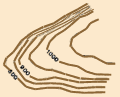
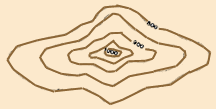
3. If y'all clearly understand the characteristics of profile lines (CL), you will be able to survey, brand contour maps and read maps much more hands. The facts to retrieve are:
Note : when two profile lines of equal acme are well-nigh each other, the land betwixt them is often flatter than the full general trend of gradient but its slope is indeterminate (unknown). Areas of indeterminate slope | | |
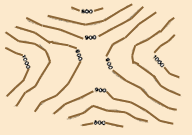
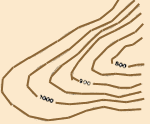
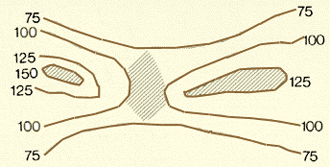
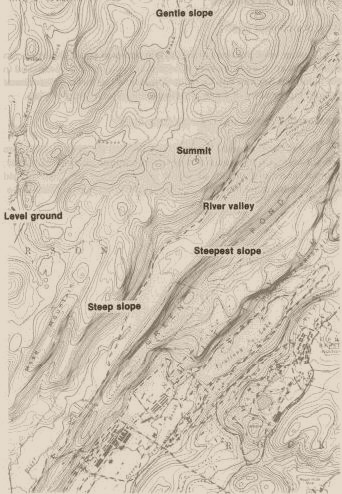
Choosing the contour interval of contour lines | |||||||||||||||||||||
| 4. Before drawing the contour lines on a plan or map, you must cull the contour interval you lot will use. The contour interval mainly depends on the accuracy or scale you need for the cartoon, and on the topography of the area (see Table 12). A smaller contour interval, such as 0.15 m, 0.25 m or 0.v 1000, is generally used for flat or gently sloping areas. Call back that well-nigh fish-farm sites are located in such areas. | | ||||||||||||||||||||
| Tabular array 12
| |||||||||||||||||||||
Making a contour map | |||||||||||||||||||||
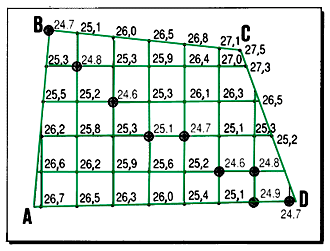
| 5. Commencement prepare a planimetric map of the area. This is a map showing the boundaries of the state, the surveying stations, the major concrete features and all bachelor details (see Sections 9.2 and nine.3). 6. Add the points of known ground acme to the map. To locate these points on the map, use a distance scale and, if necessary, a protractor for determining any angles. Write the elevations next to the points. | | ||||||||||||||||||||
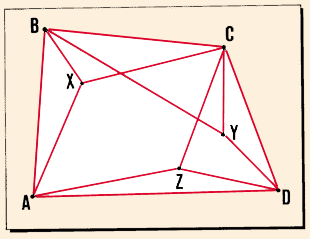
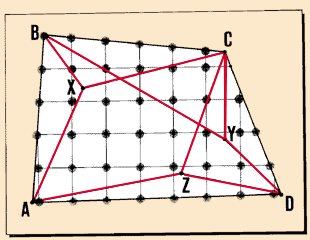
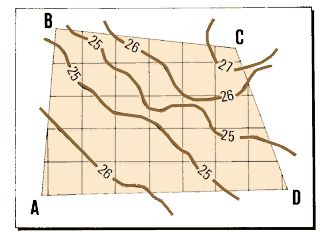
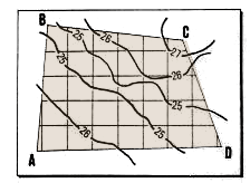
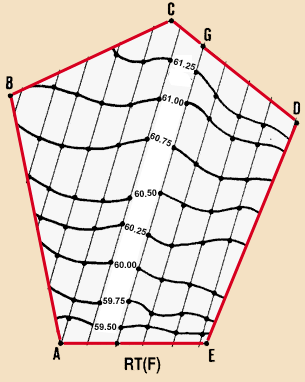
seven. Find the points of lower ground elevation . Then, according to the contour interval y'all have chosen, make up one's mind which elevation represents the first profile line yous need to describe.
eight. The first contour line volition laissez passer between basis points with elevations which are lower and higher than the meridian of the contour points. Carefully locate the path of the profile line between these higher and lower points, as you describe. Note that contour lines are commonly curved, non straight. You should draw them costless-manus, rather than using a ruler to connect the points.
| | |
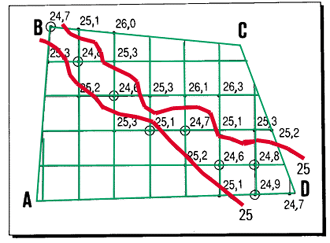
| 9. Using the aforementioned procedure, draw the other contour lines. Testify the progressively higher elevations as multiples of the selected contour interval. Annotation : contour lines are only drawn for elevations which are multiples of the contour interval. Bear witness the elevations of the contours past writing in numbers at appropriate intervals; the contour line is unremarkably broken to go out a space for the number. | | |
| 10. This general procedure may vary, depending on the contour surveying method you have used in the field. (a) If y'all have used a direct method (see Section 8.three, steps 10-29), the plan survey of the contours you lot have identified gives you all the information you need to map the corresponding profile lines. Y'all will reduce the measured distances to scale, and utilize the parallel lines marked on the ground as a background to the profile lines. (b) If you have used an indirect method (see Section 8.three, steps 30-33), you will lay out the pattern of lines roughly in the cartoon, map the points of known elevation and note their elevations. And so, estimate the position of the contour lines, as explained in a higher place. | |
9.5 How to plot longitudinal profiles
Why are longitudinal profiles plotted?
1. Longitudinal profiles are plotted to show relative elevations on a plan. When you design a fish-farm, longitudinal profiles help you to decide the road and the bottom gradient of such works as water-supply and drainage canals. They are also useful when you need to estimate the amounts of earth you need to dig out or build up on a site (called the volumes of earthwork), and when you choose sites for the structure of reservoir dams and river barrages (small dams that aqueduct the water into ditches or canals).
Information from which longitudinal profiles can be plotted | ||||||||
| ii. You plot a longitudinal profile equally a continuous line drawn through points of known elevations . The information you use for this can be:
| | |||||||
Scales to be used for longitudinal profiles | ||||||||
| 3. Y'all need two different scales to be able to plot longitudinal profiles:
Both scales should use the same unit of length. This is commonly the metre. 4. The horizontal scale of the contour should preferably be the same equally the scale of the plan or map. Example If the scale of the plan is 1 cm per metre, the horizontal calibration of the longitudinal contour should also be 1 cm per m. | | |||||||
| 5. In virtually aquaculture surveys, the differences in elevation are very small in comparison to the horizontal distances. When you plot longitudinal profiles for such a survey, yous will therefore need to make the differences in height seem larger. You can employ a vertical calibration which is from 10 to 100 times larger than the horizontal calibration. | | |||||||
| Example
| | |||||||
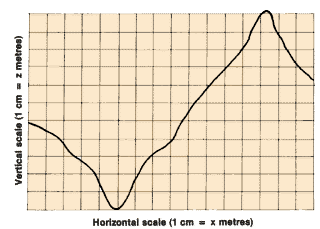
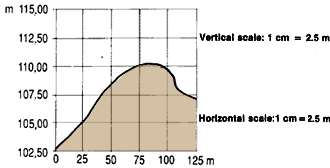
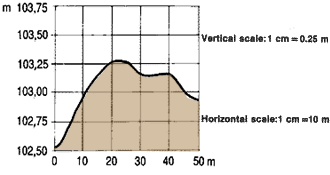
Plotting profiles from contour maps | ||
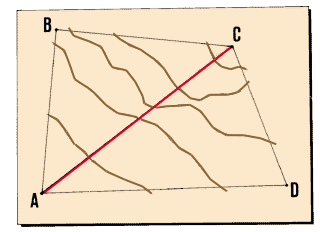
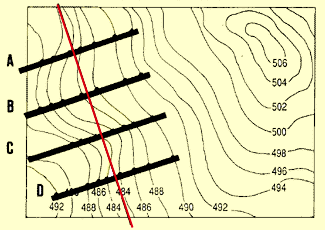
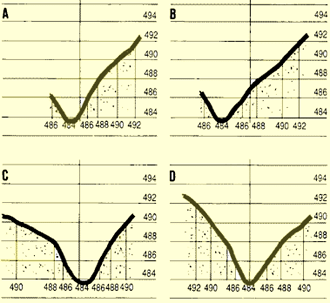
| six. Get some sheets of square-ruled millimetric paper. Or, use one canvas as a guide only, placing information technology under a sheet of transparent tracing newspaper on which you will plot your profiles. seven. On the contour map, depict line AB forth which you need to determine the longitudinal profile. Study the range of the elevations yous will plot, choose the vertical scale, and decide where to start your drawing then that it will fit within the limits of the sail of newspaper. Choose the horizontal scale equal to the scale of the contour map. | Contour interval 2 m | |
| Instance Profile map with contour interval = two thousand; | | |
| 8. Cut a strip of paper a niggling longer than the longitudinal profile AB you lot need to draw and about 2 cm broad. Identify this newspaper strip on the contour map with i edge exactly on line AB. 9. Mark points A and B with thin vertical lines to indicate the finish-points of the longitudinal profile. In a similar way, mark the position of each of the contour lines along the edge of the strip. Annotation the elevations of the main contour lines next to their marking. | | |
| 10. Place the paper strip on the drawing canvass. Its marked border should line up with the horizontal line representing the lowest meridian present (484 thousand) in the longitudinal profile. Align point A on the strip with the starting indicate of the drawing. eleven. Transfer all the pencilled marks from the paper strip to the drawing and note the main elevations next to their marks. | | |
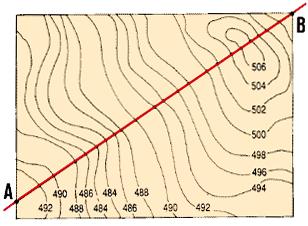
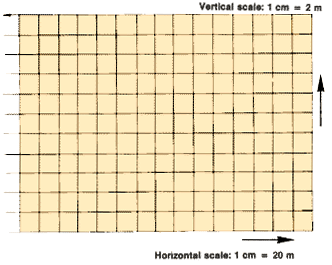
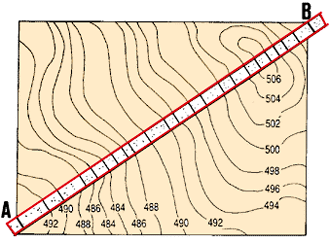
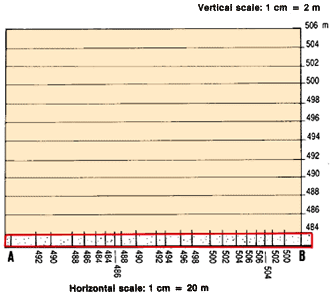
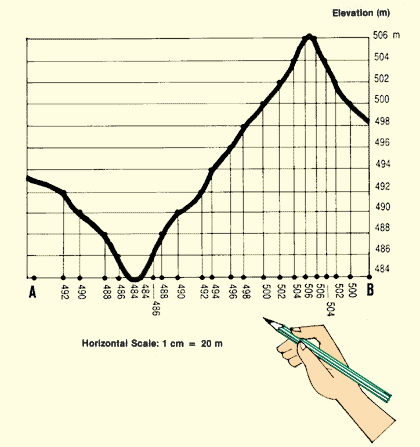
12. Using the vertical scale equally a reference, transfer each of these marks vertically upwards to the horizontal line that corresponds to its summit. Using a sharp pencil with a hard lead, make a modest circled dot at each of these points on the lines.
13. Join these points with a continuous line, which represents the longitudinal profile of the ground along selected line AB.
Notation : you lot tin can only employ this method if the horizontal calibration of your cartoon is the same equally the distance scale of the contour map.
Plotting profiles from your ain field survey | ||
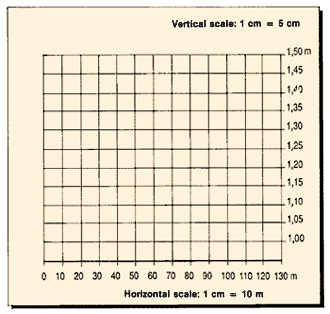
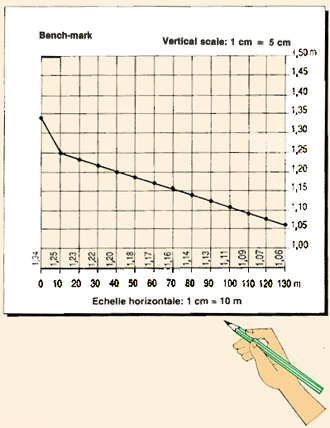
| fourteen. You tin use measurements of distances and elevations from a field survey to plot profiles. Along the horizontal centrality, get-go plot the positions of the survey stations which you have located, for example at regular intervals along a centre-line (see Section 8.2) using the horizontal scale (here 1 cm = 10 m) as a basis. Adjacent to each of these points, mark its distance from the starting point of the profile, the cumulative altitude* (in m). | | |
| 15. For each of these points, plot the elevations on vertical lines, using the vertical scale (one cm = v cm) and the two farthermost elevations (i.34 thousand and 1.06 k) as bases. 16. Join these points with a continuous line, which represents the profile of the footing along the center-line. 17. Add more information, such as the elevations of the bench-marking (BM) and of any turning point (TP). If you also plot the proposed canal slope (0.15 cm/m = 7.5 cm/ 50 yard), you can use the drawing to easily locate areas where you lot demand to raise the state to a required level (called a fill*), or places where you need to dig a aqueduct (chosen a cut*). So you tin use the drawing to judge the amount of earthwork these volition crave. | | |
9.6 How to plot cross-section profiles | ||
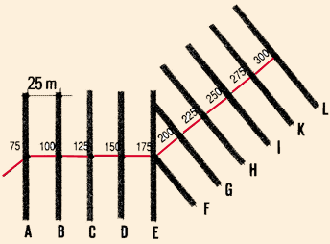
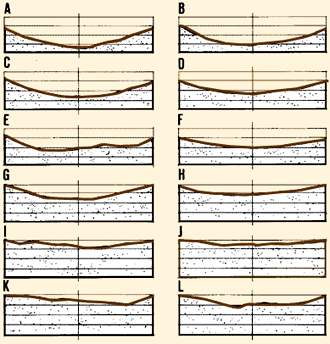
| 1. You can plot cross-section profiles either from contour maps or from levelling-survey information. ii. A expert example of when to apply a cross-section profile plotted from a profile map is for a study of a river valley when you lot want to create a water reservoir, or build a small avalanche that will raise the water level and fill up the fish-ponds past gravity. 3. If you use the information from a levelling survey, yous can plot cross-section profiles to summate volumes of earthwork when you are building h2o canals and fish-ponds, for instance (run into side by side manual on Constructions, in this series). | | |
| | ||
Plotting cantankerous-section profiles from contour maps | ||
| 4. On the contour map, depict the lines forth which you lot will written report the profiles. These lines should be perpendicular to a longitudinal profile. v. Become several sheets of foursquare-ruled millimetric newspaper, or apply one sheet as a guide only, nether transparent tracing paper. Plot the cross-department profiles with the aid of a marked newspaper strip (as described in Section 9.5, steps 8-13). | Calibration: 1 cm = twenty m | |
| vi. Remember that:
| Cross-sections of a valley | |
Plotting cross-department profiles for earthwork estimates | ||
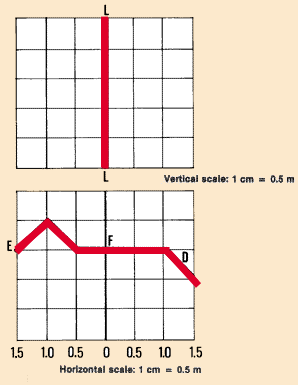
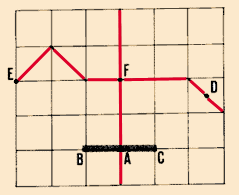
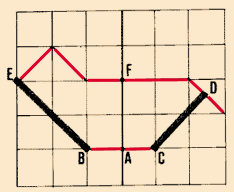
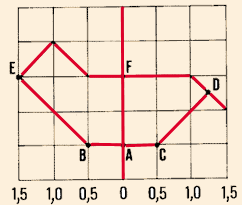
| 7. To estimate how much earthwork you need to do, you lot can commonly plot cross-sections to a calibration of either 1 cm per metre or 1 cm per 0.five m . Use the larger scale when the amount of a cutting or fill is small. Horizontal scales and vertical scales should be identical, and then that you can obtain a truthful surface expanse from the scaled dimensions. 8. You lot tin plot all-time on square-ruled millimetric paper or use 1 sheet of such paper every bit a guide placed under a sail of transparent tracing paper. 9. Describe a vertical centre-line (LL) representing the middle-line of the cross-department contour. LL should follow 1 of the heavier lines of the squared-ruled paper. 10. On both sides of this centre-line, depict the ground profile EFD on the basis of your levelling data, using the horizontal calibration for distances and the vertical calibration for elevations. | | |
| 11. From your longitudinal profile, locate point A on line LL. In the example, it represents the elevation of the bottom of the canal at this particular levelling station (run across Section 9.v, step 17). 12. Through bespeak A, describe a horizontal line BAC to show the canal bottom. Make sure that AB = AC, and each is one-half the width of the canal bottom. | | |
| 13. Through B and C, draw lines BE and CD representing the sides of the canal (for example, with a slope of 1.5: 1). These ii lines intersect the ground surface at points E and D. 14. The cantankerous-section EBACDFE represents a vertical section of the earth. Yous tin can so easily calculate the surface area of this cross-section (meet, for example, Section ten.3). Using this area every bit a footing, you tin can estimate the book of earth you need to remove from this location along the centre-line of the culvert. | | |
| | ||

peeblessoogniny1973.blogspot.com
Source: https://www.fao.org/fishery/static/FAO_Training/FAO_Training/General/x6707e/x6707e09.htm
0 Response to "How to Draw a Ridge in a Site Plan"
Postar um comentário